
“Cat, hat, bat!” Your child repeats the words, laughs and looks around for something else that rhymes. This playful discovery makes rhyming words for kindergarten enjoyable to explore. Through pictures, songs and everyday conversations, children can notice matching sounds while learning new words and gaining confidence in spoken English.
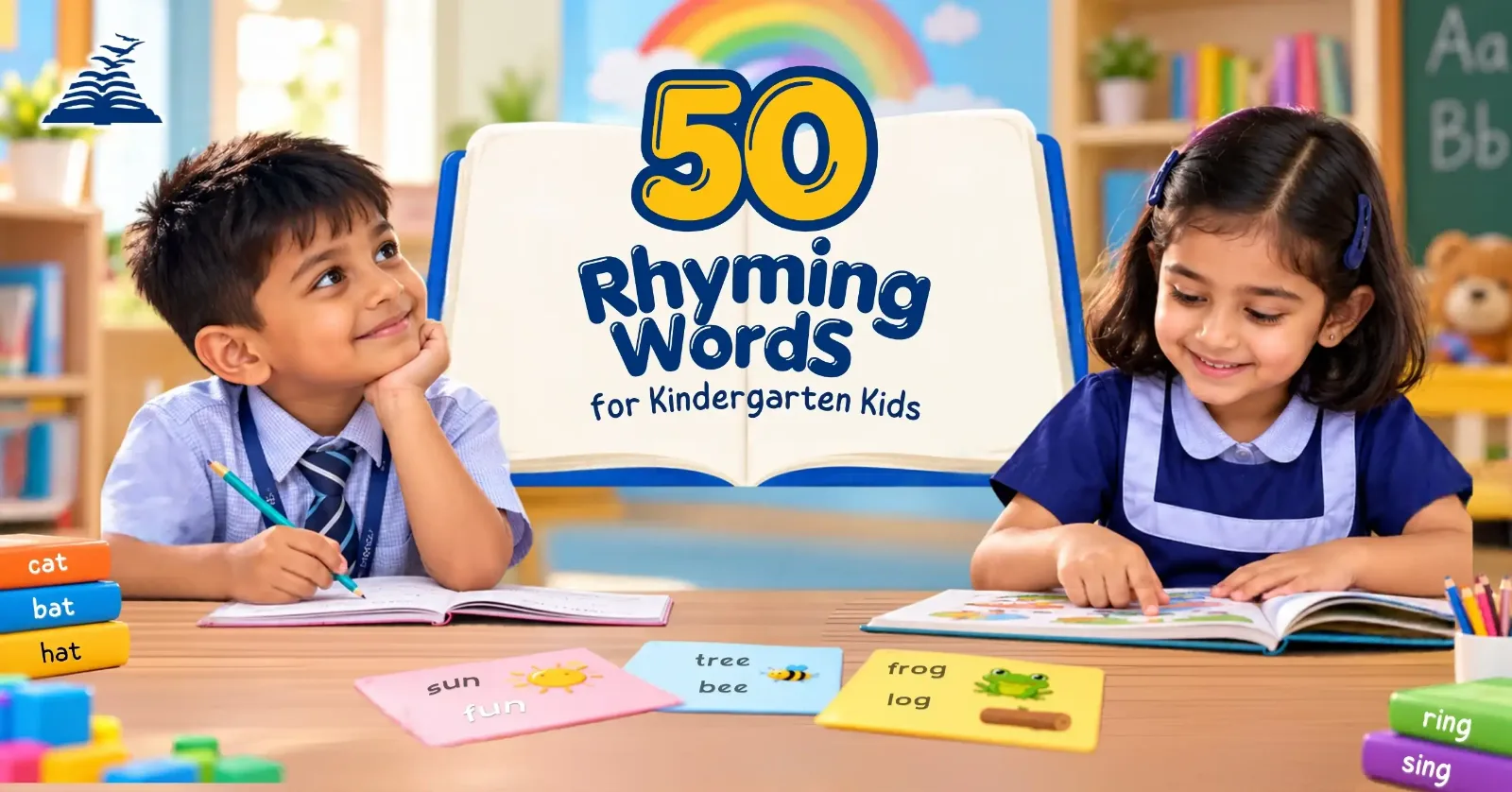
Table of Contents
What Are Rhyming Words? Simple Examples for Beginners
Rhyming words in English have matching ending sounds. “Cat” and “hat” rhyme because both end with the sound “at.” Say them slowly, then emphasise their endings. Children can listen for the match even before they can read the words independently.
Sound matters more than spelling. For example, “blue” and “shoe” rhyme despite their different spellings. Begin with clear, familiar examples and help children hear the difference between a rhyming pair and two words that simply start alike.
How Rhyming Helps Children Develop Early Language Skills
Practising easy rhyming words for Kids draws attention to sounds within spoken language. Children can explore how changing the beginning of a word creates another word. These activities also introduce vocabulary and encourage listening, speaking and participation, especially when children explain a picture or complete a familiar line.
List of 50 Easy Rhyming Words for Kindergarten Kids
This rhyming words list includes 50 different words across ten word families. Each family contains five words. Introduce a few at a time, explain unfamiliar meanings and let children practise aloud before expecting written work.
The “-at” and “-an” Word Families: Cat, Hat, Pan and Fan
Start with simple rhyming words that connect to familiar objects. Show pictures of a cat, hat, pan and fan. Say each name and invite children to group the pictures according to their matching endings.
| Word family | Five rhyming words |
| -at | Cat, hat, bat, mat, rat |
| -an | Pan, fan, man, can, ran |
The “-ig” and “-in” Word Families: Pig, Wig, Pin and Fin
A pig wearing a wig makes a memorable drawing. For the second family, show a fish’s fin or a recycling bin. Name each picture clearly so children understand the word as well as its sound.
| Word family | Five rhyming words |
| -ig | Pig, wig, big, dig, fig |
| -in | Pin, fin, tin, win, bin |
The “-op” and “-og” Word Families: Hop, Mop, Dog and Log
Add movement by inviting children to hop, then pretend to use a mop. Pictures can introduce the animal words. Explain that “hog” means a pig and “cop” is an informal word for a police officer.
| Word family | Five rhyming words |
| -op | Hop, mop, top, pop, cop |
| -og | Dog, log, fog, jog, hog |
The “-en” and “-et” Word Families: Hen, Pen, Pet and Net
Teachers at ICSE schools in Banashankari can use animal pictures, counting and classroom objects to practise these families. Children might count ten pens or draw a pet beside a net, then say the matching words.
| Word family | Five rhyming words |
| -en | Hen, pen, ten, men, den |
| -et | Pet, net, jet, wet, set |
The “-ug” and “-un” Word Families: Bug, Hug, Sun and Fun
Draw a bug on a rug or a bun beneath the sun. Let children describe the pictures and suggest matching words. Introduce “pun” as a joke that plays with words; explain unfamiliar vocabulary without expecting immediate mastery.
| Word family | Five rhyming words |
| -ug | Bug, hug, mug, rug, tug |
| -un | Sun, fun, run, bun, pun |
Simple Sentences and Short Rhymes Using Rhyming Words
Short sentences give the words meaning. Read these aloud and ask children to identify the matching endings:
- The cat sat on a mat.
- A hen stood beside ten men.
- The dog jumped over a log.
- A bug crawled across the rug.
Try this original rhyme:
“A little cat Found a hat, Then curled up On a mat.”
Fun Activities to Teach Rhyming Words
Parents exploring the best kindergarten schools in Bangalore can ask how teachers use stories, pictures and games for early language learning. A useful activity gives children time to listen, respond and try again when they are unsure.
Picture Matching, Rhyming Bingo and Odd-One-Out Games
At play schools in Banashankari, teachers can adapt these games to children’s familiarity with English:
- Picture matching: pair a hen with a pen.
- Rhyming bingo: hear “cat” and cover a hat picture.
- Odd-one-out: choose the non-rhyming word from “pig, wig, sun.”
Name pictures aloud before playing.
Nursery Rhymes, Songs and Fill-in-the-Blank Activities
Choose rhyming books and songs with clear language and repeated patterns. Read a line once, then pause before its final word. Let children complete it using a picture clue, and discuss what the line means.
Use rhyming words worksheets with simple picture choices. For example, “The dog sat beside a ______” could offer pictures of a log and a fan. Say the choices aloud so beginners can participate through listening.
Tips for Parents and Teachers to Practise Rhyming Every Day
Teachers at top ICSE schools in Bangalore can share familiar word families with parents for playful practice at home. Choose moments such as story time or tidying toys. Say “rug” and invite your child to find a matching word.
Keep practice brief, accept thoughtful attempts and demonstrate corrections gently. Children do not need to memorise all 50 words together. Revisit familiar pairs, introduce new meanings gradually and enjoy their ideas.
A Joyful Start to Language at Presidency School Banashankari
A rhyme repeated with a smile can spark a child’s interest in words and sounds. Presidency School Banashankari encourages young learners to enjoy language, express themselves and develop the foundations of communication. Exploring rhyming words for kindergarten kids offers a playful way to practise listening, discover vocabulary and gain confidence in speaking. With an emphasis on early learning and personal growth, the school gives children room to be curious, creative and eager for their next discovery.
Conclusion
When your child suggests a rhyme of their own, pause and enjoy the discovery together. These rhyming words for kindergarten offer plenty of starting points for songs, silly sentences and picture games. Let listening and speaking lead the activity, and explain new words as they appear. A few cheerful minutes of practice can help children notice matching sounds and feel more comfortable experimenting with English. Follow their interest and leave room for laughter along the way.