Somewhere between memorising times tables and learning the periodic table, most Indian students also end up memorising a map — 28 states, 8 union territories, and a capital for each one that refuses to stick until it’s revised at least three times. Getting a clear, accurate grip on Indian states and their capitals matters well beyond exam season too, coming up in general knowledge tests, competitive exams, and even everyday conversations about where someone’s from. This guide lays the whole list out clearly, region by region, along with a few tricks that actually make it easier to remember.
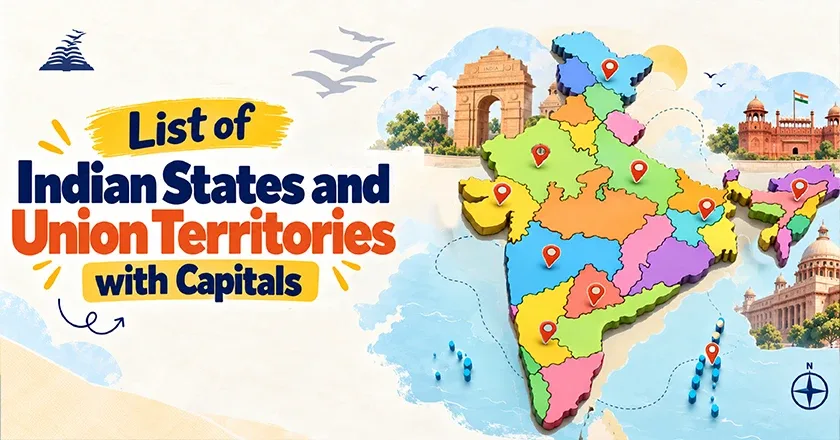
Table of Contents
India’s Current Administrative Structure
India has 28 states and 8 union territories. States have their own elected governments. Union Territories are administered under arrangements set by the Union government; Delhi, Puducherry and Jammu and Kashmir also have legislative assemblies. The regional groups below are a learning aid, not official administrative divisions.
List of 28 Indian States and Their Capitals
The following States and capitals of India are arranged in six broad regions. Read each table from left to right, then cover the capital column and test yourself. The capital pairs are based on the National Portal of India, with additional notes for places that have a second or seasonal capital.
North Indian States and Capitals
| State | Capital |
| Haryana | Chandigarh |
| Himachal Pradesh | Shimla |
| Punjab | Chandigarh |
| Uttar Pradesh | Lucknow |
| Uttarakhand | Dehradun |
Chandigarh is the shared capital of Punjab and Haryana, while also being a Union Territory. Himachal Pradesh has designated Dharamshala as its second capital. Uttarakhand lists Dehradun as its temporary capital and Gairsain as its summer capital.
South Indian States and Capitals
| State | Capital |
| Andhra Pradesh | Amaravati |
| Karnataka | Bengaluru |
| Kerala | Thiruvananthapuram |
| Tamil Nadu | Chennai |
| Telangana | Hyderabad |
Amaravati is the capital of Andhra Pradesh. It is useful to remember it separately from Hyderabad, which is the capital of Telangana.
East Indian States and Capitals
| State | Capital |
| Bihar | Patna |
| Jharkhand | Ranchi |
| Odisha | Bhubaneswar |
| West Bengal | Kolkata |
West Indian States and Capitals
| State | Capital |
| Goa | Panaji |
| Gujarat | Gandhinagar |
| Maharashtra | Mumbai |
| Rajasthan | Jaipur |
Mumbai is Maharashtra’s principal capital. Nagpur is also recognised as its winter capital, where the state legislature holds a winter session.
Central Indian States and Capitals
| State | Capital |
| Chhattisgarh | Raipur |
| Madhya Pradesh | Bhopal |
Northeastern States and Capitals
| State | Capital |
| Arunachal Pradesh | Itanagar |
| Assam | Dispur |
| Manipur | Imphal |
| Meghalaya | Shillong |
| Mizoram | Aizawl |
| Nagaland | Kohima |
| Sikkim | Gangtok |
| Tripura | Agartala |
The Northeast has eight states. Remembering them as one group can make the full list easier to revise, especially when several capitals are less familiar than the cities students hear about most often.
List of 8 Union Territories and Their Capitals
The Indian states and union territories list is complete only when the eight Union Territories are included. Four are grouped under the northern heading below. The remaining four include southern, island and western coastal territories.
Northern Union Territories and Capitals
| Union Territory | Capital |
| Chandigarh | Chandigarh |
| Delhi (National Capital Territory) | New Delhi |
| Jammu and Kashmir | Srinagar (summer); Jammu (winter) |
| Ladakh | Leh |
Jammu and Kashmir has seasonal capitals: Srinagar in summer and Jammu in winter. Ladakh is a separate Union Territory, so it should not be placed in the list of states.
Southern and Island Union Territories and Capitals
| Union Territory | Capital |
| Andaman and Nicobar Islands | Port Blair/ Sri Vijaya Puram |
| Dadra and Nagar Haveli and Daman and Diu | Daman |
| Lakshadweep | Kavaratti |
| Puducherry | Puducherry |
Dadra and Nagar Haveli and Daman and Diu is a western coastal Union Territory, included here to complete the eight. The capital of the Andaman and Nicobar Islands was renamed Sri Vijaya Puram from Port Blair in 2024; Daman is the capital of the merged western territory.
Difference Between Indian States and Union Territories
A state generally has an elected government led by a chief minister and powers assigned under India’s constitutional system. A Union Territory has a different administrative arrangement, with a Lieutenant Governor or Administrator acting under the Union government. Delhi, Puducherry and Jammu and Kashmir are important exceptions to remember because they have elected legislative assemblies.
Easy Ways to Remember Indian States and Capitals
Practise the states and their capitals of India in small regional groups. Start with the five southern states, for example, before moving to the Northeast. Once you can recall a group without looking, mark its capitals on a blank map. Seeing their locations helps the names stick.
Teachers at the best ICSE schools in Bangalore can turn the tables into a quick classroom activity: one student names a state, another names its capital, and a third points to it on a map. This adds location to simple memorisation.
Students at the top ICSE schools in Banashankari can also make flashcards for pairs they mix up, such as Assam–Dispur and Gujarat–Gandhinagar. Revise those cards more often than pairs you already know.
Explore India’s Geography with Presidency School Banashankari
Learning the names and capitals of India’s states and Union Territories helps students understand the country’s regions, diversity and administrative structure. At Presidency School Banashankari, curiosity about topics such as geography can encourage learners to connect classroom knowledge with the world around them. With a focus on learning and all-round growth, the school supports students as they build knowledge and confidence for the future.
Conclusion
Learning India’s states, Union Territories and capitals becomes much easier when students move beyond memorising one long list. Grouping places region-wise, using maps, practising with flashcards and revising commonly confused pairs can turn geography into a more engaging learning exercise. Understanding the Indian states and their capitals also helps students build stronger general knowledge and prepare for school assessments, quizzes and competitive examinations. Just as importantly, recognising the difference between states and Union Territories gives learners a clearer picture of India’s administrative structure. With regular map practice and short revision sessions, students can remember these names more confidently while developing a better understanding of the country’s geographical and political organisation.