A child’s first experience of school can shape how they feel about learning for years. A welcoming classroom can turn hesitation into curiosity, while a thoughtful teacher can help a quiet child find the confidence to participate.
When comparing the best Kindergarten Schools in Bangalore, parents should look beyond colourful walls, digital boards and impressive brochures. The right environment should make children feel secure while supporting language, movement, creativity, independence and social development.
Why Choosing the Right Kindergarten Matters
Kindergarten is not simply a smaller version of primary school. Young children learn most effectively through play, conversation, stories, movement, observation and interaction with real materials.
A suitable programme helps children:
- Communicate their needs and ideas.
- Develop fine- and gross-motor coordination.
- Follow simple routines independently.
- Build friendships and cooperate with others.
- Express emotions appropriately.
- Develop early language and number awareness.
- Approach unfamiliar experiences with confidence.
The best preschool in Bangalore for one child may not necessarily suit another. Parents should consider temperament, developmental readiness, learning pace, travel time and the level of emotional support available.
Understanding Different Kindergarten Curricula and Teaching Approaches
Kindergarten programmes may follow Montessori, play-based, thematic, inquiry-oriented or blended approaches. Schools connected to CBSE or ICSE institutions may also design their early-years curriculum to support a smooth transition into primary education.
The Teaching-Learning Methodology matters more than the name attached to the programme. Parents should examine whether teachers explain, demonstrate, observe and guide—or rely heavily on worksheets and memorisation.
| Approach | Common Features | What Parents Should Observe |
| Play-based | Stories, games and exploration | Children have meaningful choices |
| Montessori-inspired | Self-directed work with learning materials | Teachers guide without rushing |
| Thematic | Subjects connected through a central theme | Activities build understanding |
| Inquiry-based | Questions, investigation and discussion | Children are encouraged to think aloud |
| Blended | Combination of structured and exploratory learning | Formal tasks remain age-appropriate |
Key Factors to Consider When Comparing Kindergarten Schools
Online lists of the Top 10 Preschools in Bangalore may provide a useful starting point, but they cannot reveal how teachers respond when a child is upset, confused or reluctant to participate. A campus visit remains essential.
Play-Based, Experiential and Age-Appropriate Curriculum
A developmentally appropriate curriculum introduces early literacy and numeracy through meaningful experiences. Children may count objects, identify patterns, listen to stories, experiment with colours or learn new words through conversations.
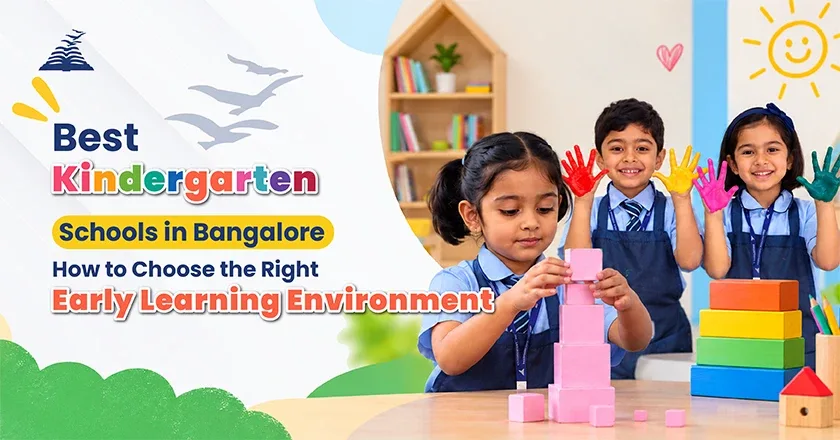
Play should have a genuine place in the timetable. Building blocks, puzzles, pretend-play materials, sensory resources and nature-based activities encourage learners to explore without expecting identical results from everyone.
Qualified Teachers and a Supportive Student–Teacher Ratio
Early-years teachers need knowledge of child development, classroom management and age-appropriate teaching. They should understand that children settle into school at different speeds.
A manageable student–teacher ratio allows educators to observe individual progress, communicate with families and respond sensitively when children require reassurance or additional guidance.
Ask whether assistants are available, how teachers receive professional development and who supervises children during outdoor play, meals and washroom visits.
Safe, Hygienic and Child-Friendly Infrastructure
Strong safety and security practices should include controlled entry, authorised pickup, supervised movement, accessible first aid and clear emergency procedures.
Furniture, washrooms, stairways and play equipment should be appropriate for young children. Classrooms require adequate light and ventilation, while toys and frequently touched surfaces should be cleaned regularly.
Parents should also check drinking-water arrangements, food practices, CCTV policies and how the school responds if a child becomes unwell.
Indoor Activities, Outdoor Play and Creative Exploration
Kindergarten children need regular opportunities to run, climb, balance, build, draw, sing and imagine. Long periods of sitting can make learning tiring and developmentally unsuitable.
Well-planned Extracurricular Activities may include music, dance, storytelling, art, yoga, simple sports and nature exploration. At this age, participation and enjoyment should receive greater importance than competition or polished performances.
Focus on Social, Emotional and Communication Skills
A strong programme helps children name emotions, wait for their turn, share materials, listen to others and resolve small disagreements with guidance.
Teachers should encourage conversation without forcing children to speak before they feel comfortable. Stories, puppets, group games and role-play can help learners develop vocabulary and social confidence naturally.
Emotional development also depends on how adults respond to mistakes. Children learn more confidently when correction is calm, respectful and constructive.
Strong Parent–Teacher Communication and Progress Updates
Communication should explain how the child is adjusting, interacting, participating and developing—not merely list academic tasks completed.
Families exploring the top nursery schools in Bangalore should ask whether progress is shared through meetings, observations, portfolios, digital platforms or written reports. Parents should also know whom to contact when an immediate concern arises.
Kindergarten Age Criteria and Admission Requirements in Bangalore
India’s National Curriculum Framework describes the Foundational Stage as ages three to eight, covering three years of preschool followed by Grades 1 and 2. It also indicates that children should generally begin Grade 1 at six.
However, kindergarten names and cutoff dates can vary between schools, and Karnataka may issue year-specific admission directions or relaxations. Parents should confirm current eligibility through the school.
Schools commonly request:
- A completed application form.
- Birth certificate.
- Passport-size photographs.
- Address and identity proof.
- Previous-school records, if applicable.
- Health or immunisation details, where requested.
- An interaction involving the child and parents.
Any interaction should help the school understand the child’s readiness rather than test advanced reading or writing.
Evaluating Location, Transportation and School Fees
Parents considering the top schools in Bangalore should calculate the complete annual cost, including tuition, admission charges, books, uniforms, meals, activities, transport and daycare where applicable.
A conveniently located school can reduce fatigue and make daily routines easier. Long journeys may affect sleep, breakfast, playtime and willingness to attend school.
Families considering ICSE Schools in Bangalore should ask about transport routes, bus attendants, GPS tracking, pickup procedures and expected travel duration during peak traffic.
Before selecting a ICSE Schools in Banashankari, parents should visit at regular arrival or departure time to understand traffic, parking, security and the organisation of student handovers.
Questions Parents Should Ask During a Kindergarten Campus Visit
Ask the school:
- What does a typical kindergarten day include?
- How much time is devoted to free and outdoor play?
- How are children supported during the settling-in period?
- What qualifications do teachers possess?
- How are developmental differences addressed?
- How frequently is screen-based content used?
- How are toilet needs and meal times managed?
- What are the safety and emergency procedures?
- How is progress communicated to parents?
- What is the complete fee and refund policy?
Watch how teachers speak to children and whether classrooms feel calm, active and welcoming. The right kindergarten is one where children are not merely kept busy—they are understood, encouraged and given room to grow.
Choosing an Early Learning Environment Where Children Can Truly Flourish
When parents compare the best kindergarten schools in Bangalore, the right choice should offer more than basic academics—it should provide a safe, joyful, and stimulating environment where children feel confident to explore and learn. At Presidency School Banashankari, kindergarten education focuses on nurturing curiosity through play-based learning, storytelling, creative activities, language development, movement, social interaction, and hands-on experiences. Caring educators support each child’s emotional, cognitive, physical, and social growth while encouraging independence and positive learning habits. With a balanced approach that combines strong early foundations with creativity and care, Presidency School Banashankari helps young learners begin their school journey with confidence, enthusiasm, and a lasting love for learning.
Conclusion
Choosing the right kindergarten is ultimately about finding a place where a child feels safe enough to explore, confident enough to communicate, and curious enough to enjoy learning. Parents comparing the Best Kindergarten Schools in Bangalore should look closely at teacher-child interaction, play-based learning, emotional support, safety, class routines, outdoor opportunities, communication practices, and daily travel demands. Facilities and curriculum matter, but the strongest early-learning environments are those that respect each child’s developmental pace and make room for movement, imagination, relationships, and independence. A thoughtful campus visit can help parents identify the setting where their child is not simply prepared for primary school, but genuinely encouraged to grow into an enthusiastic and self-assured learner.