Nothing in nature eats without also, eventually, being eaten. That simple, slightly unsettling truth is the whole idea behind a food chain and once you see it clearly, you start noticing it everywhere, from a garden ant carrying a crumb to a hawk circling a field.
What Is a Food Chain?
If you are wondering what is a food chain, the short version is this: it is a straight-line sequence showing who eats whom in a habitat, starting with a plant and ending with a top predator or a decomposer. Each link in that line depends entirely on the one before it for energy.
More formally, the food chain definition used in most biology textbooks describes it as the transfer of energy and nutrients from one organism to another through a series of eating and being-eaten relationships, usually beginning with a producer and moving upward through consumers.
Main Components of a Food Chain
Every food chain, no matter how long or short, is built from the same handful of roles only the species filling them changes from one habitat to the next.
Producers, Consumers, Decomposers and Trophic Levels
Producers (mostly green plants and algae) sit at the base, making their own food through photosynthesis. Everything above them is a consumer, and consumers themselves split into tiers depending on what they eat. Understanding how a food chain in ecosystem terms actually functions means recognising that each of these roles occupies a distinct trophic level a rung on the energy ladder.
| Component | Role | Example |
| Producers | Make their own food via photosynthesis | Grass, algae, trees |
| Primary Consumers | Herbivores that eat producers | Deer, grasshopper, zooplankton |
| Secondary Consumers | Carnivores/omnivores that eat herbivores | Frog, small fish, fox |
| Tertiary Consumers | Top predators that eat other consumers | Eagle, tiger, shark |
| Decomposers | Break down dead matter, recycle nutrients | Fungi, bacteria, earthworms |
How Does a Food Chain Work?
Energy always moves in one direction from the sun, into producers, and upward through each consumer level. It never flows backward, and it never skips a level cleanly; some of it is lost at every single step along the way.
Direction of Energy Flow and the 10% Energy Transfer Rule
Only about 10% of the energy available at one trophic level actually makes it to the next the rest is used up in the organism’s own movement, metabolism, and body heat, or lost as waste. So, if grass captures 1,000 units of energy from sunlight:
- A grasshopper eating that grass gains roughly 100 units
- A frog eating the grasshopper gains roughly 10 units
- A snake eating the frog gains roughly 1 unit
This is exactly why food chains rarely run past four or five links there is simply not enough energy left by the top of the chain to support many more levels.
What Are the Different Types of Food Chains?
Broadly, food chain types fall into two categories, depending on where the chain actually begins with a living plant, or with dead organic matter.
Grazing Food Chain and Detritus Food Chain
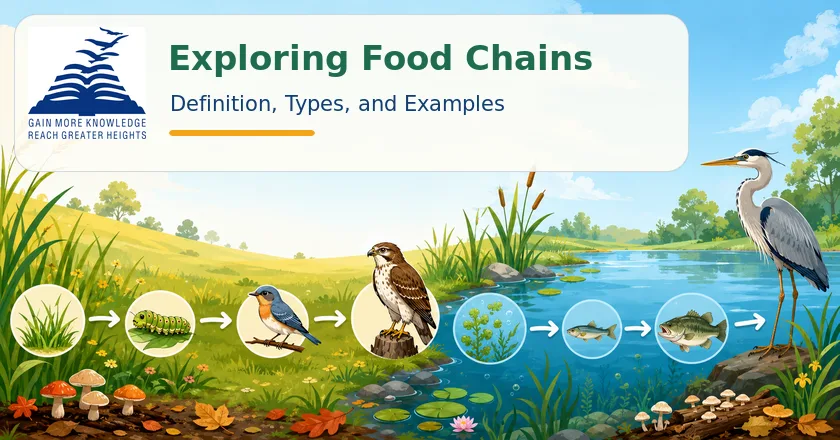
A grazing food chain starts with a living green plant, moves to a herbivore that eats it, and continues up through carnivores’ grass to grasshopper to frog to snake, for instance. A detritus food chain works differently: it starts with dead organic matter (fallen leaves, animal remains) broken down by decomposers and detritivores like earthworms and fungi, which are in turn eaten by other small organisms. Both Types of Food Chain exist side by side in the same habitat, and together they are what actually keeps an ecosystem’s nutrients cycling instead of dead-ending.
Food Chain Examples from Different Ecosystems
The general structure stays the same everywhere, but the actual species involved shift completely depending on climate and habitat. A few concrete food chain examples make this easier to picture than any definition on its own.
Forest, Grassland, Desert and Aquatic Food Chain Examples
| Ecosystem | Example Food Chain |
| Forest | Leaves → Caterpillar → Small bird → Hawk |
| Grassland | Grass → Grasshopper → Frog → Snake → Eagle |
| Desert | Desert shrub → Kangaroo rat → Rattlesnake → Hawk |
| Aquatic (Pond/Ocean) | Phytoplankton → Zooplankton → Small fish → Larger fish |
Teaching this comparatively habitat by habitat, rather than as one abstract diagram is exactly the kind of approach the science curriculum at a top ICSE school in Bangalore tends to favour, since ICSE’s Environmental Science component leans heavily on comparing real ecosystems rather than memorising a single textbook chain.
What Is the Difference Between a Food Chain and a Food Web?
A food chain is a single, straight line one producer, one path, one predator at the end. Real ecosystems are never that tidy; most species eat more than one thing and get eaten by more than one predator, which is where a food web comes in.
| Food Chain | Food Web |
| Single, linear sequence | Multiple interconnected food chains |
| One organism per trophic level | Several organisms can share a trophic level |
| More vulnerable if one species disappears | More resilient due to alternate energy paths |
| Simple to diagram | Complex, network-like structure |
Importance of Food Chains and the Effects of Their Disruption
The importance of food chain structures goes well beyond biology-class diagrams they are a working model of how energy and nutrients actually move through the real world, and they explain why removing even one species can ripple outward in ways that are not obvious at first. Take out a top predator, and prey populations can explode unchecked; remove a keystone species, and the effects cascade through every level connected to it. Pollutants behave the same way in reverse a small amount of pesticide in producers can become dangerously concentrated by the time it reaches a top predator, a process called biomagnification.
This is also, practically speaking, why food chains and food webs remain a recurring theme across a full academic year rather than a single chapter a best ICSE school in Bangalore will typically revisit the concept through field trips, project work, and ecosystem case studies, precisely because a diagram alone doesn’t make the real-world stakes of disruption sink in the way an actual pond-dipping exercise or a forest trail does.
Bringing Science to Life Through the Study of Food Chains
Exploring food chains, their definition, types, and examples help students understand how living organisms depend on one another and how energy moves through an ecosystem. At Presidency School Banashankari, science learning is made more engaging through observation, diagrams, classroom discussions, projects, and real-world examples that connect textbook concepts with nature around us. By studying producers, consumers, predators, prey, and decomposers, students develop a clearer understanding of ecological balance while strengthening their analytical and scientific thinking skills. This hands-on and concept-driven approach encourages curiosity, environmental awareness, and a deeper appreciation of the natural world.
Conclusion
Food chains reveal how closely every living organism in an ecosystem is connected. From producers capturing energy to consumers transferring, it and decomposers returning nutrients to the environment, each link plays an essential role in maintaining ecological balance. Understanding different food chain types, trophic levels, energy flow, and food webs helps students see why even a small disturbance can affect an entire habitat. More importantly, learning about food chains encourages greater awareness of biodiversity, conservation, and responsible interaction with nature. Once students understand how energy moves through an ecosystem, they also begin to understand why protecting every level of that system matters.