
Measurements are used in many parts of daily life, from classroom learning and craft activities to shopping, tailoring, construction, and science projects. Students often come across measurements in different units, especially inches and centimetres. Understanding conversion helps them compare sizes correctly and solve problems easily. A simple Inches to Centimeters Converter helps learners understand how values change from one unit to another.
Understanding the Meaning of Inch and Centimetre
Before learning conversion, students should understand the basic meaning of both units. An Inch Definition can be explained simply as a small unit of length used to measure objects, height, width, and distance. For example, the size of a mobile screen, television, or laptop is often mentioned in inches.
Why Inch to CM Conversion Is Important
A Centimeter Definition is also easy to understand. A centimetre is a unit of length in the metric system, and it is commonly used in India for classroom learning, rulers, charts, notebooks, and science experiments. Since many measurements are written in centimetres, students must know how to convert from inches when needed.
Simple Formula to Convert Inches to Centimetres
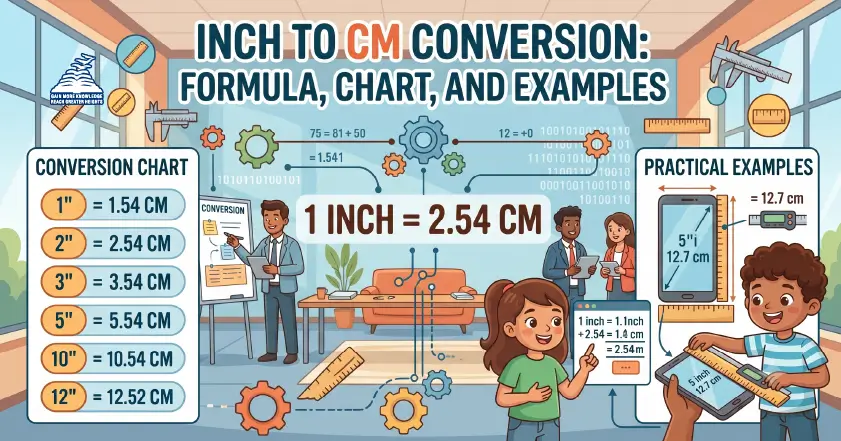
The Inches to cm formula is very simple:1 inch = 2.54 centimetres.
To convert inches into centimetres, multiply the number of inches by 2.54. For example, if a pencil is 5 inches long, its length in centimetres will be 5 × 2.54 = 12.7 cm.
How 1 Inch Equals 2.54 Centimetres
The value 2.54 is internationally accepted for converting inches into centimetres. The Inches to Cm Formula helps students avoid confusion when they see measurements in different formats. Whether the measurement is for a screen, book, ruler, box, or chart paper, the same formula can be used every time.
Step-by-Step Method for Inch to CM Conversion
An Inch to cm calculator may give instant answers, but students should also know the manual method. First, write the value in inches. Second, multiply it by 2.54. Third, write the answer in centimetres. This step-by-step method helps students understand the process instead of only depending on digital tools.
Convert 8 inches to centimetres.
8 × 2.54 = 20.32 cm
So, 8 inches = 20.32 cm.
Easy Examples of Inch to CM Conversion
A simple Inches to Centimetre Conversion Chart can help students remember common values. Such charts are useful during homework, maths practice, craft activities, and measurement-based projects.
| Inches | Centimetres |
| 1 inch | 2.54 cm |
| 2 inches | 5.08 cm |
| 3 inches | 7.62 cm |
| 4 inches | 10.16 cm |
| 5 inches | 12.70 cm |
| 10 inches | 25.40 cm |
| 12 inches | 30.48 cm |
| 20 inches | 50.80 cm |
Common Inch to CM Conversion Values
Students may also need to Convert Centimeters to Inches in some situations. For this, they can divide the centimetre value by 2.54. For example, if a notebook is 25.4 cm long, then 25.4 ÷ 2.54 = 10 inches. This reverse method is useful when comparing metric and non-metric measurements.
Difference Between Inches and Centimetres
Inches and centimetres both measure length, but they belong to different systems of measurement. Inches are part of the imperial system, while centimetres are part of the metric system. A centimetre is smaller than an inch, so the number in centimetres is always larger when the same object is converted from inches.
| Point of Difference | Inch | Centimetre |
| Measurement system | Imperial system | Metric system |
| Short form | in | cm |
| Size | Bigger than a centimetre | Smaller than an inch |
| Common use | Screens, furniture, height | Rulers, school work, science |
| Conversion value | 1 inch | 2.54 cm |
Where Inch to CM Conversion Is Used in Daily Life
Students in the best icse schools in Bangalore often learn measurement conversions through practical examples. Inch to CM conversion is used while measuring school projects, craft materials, display boards, chart paper, book sizes, furniture, bags, and electronic devices. It helps children connect maths with real-life situations.
Inch to CM Conversion for Students and Beginners
The top ICSE schools in Bangalore encourage students to understand measurement concepts through activities rather than memorising only formulas. Beginners can start with small values like 1 inch, 2 inches, 5 inches, and 10 inches. Once they become comfortable, they can try larger numbers and word problems.
Tips to Remember Measurement Conversions Easily
Many best schools in Bangalore teach students simple tricks to remember conversions. The most important tip is to remember that 1-inch equals 2.54 cm. Students can practise using rulers, measuring tapes, classroom objects, and worksheets. Repeated practice makes conversion faster and more accurate.
Helpful tips include:
- Memorise 1 inch = 2.54 cm
- Practise with small numbers first
- Use a ruler to compare both units
- Make a small conversion chart
- Solve daily-life examples
- Check answers by estimating the size
Learning Measurements Through Simple Practice Examples
Measurement becomes easier when students practise with real objects. They can measure a pencil, notebook, lunch box, water bottle, or classroom board in inches and then convert the value into centimetres. This makes learning more practical and enjoyable.
Understanding Inch to CM Conversion in a Simple Way
Learning Inch to CM conversion helps students understand measurements more clearly and apply them in everyday situations such as measuring height, length, objects, charts, and classroom activities. At Presidency School Banashankari, students are guided to learn measurement concepts through simple explanations, practical examples, and activity-based learning. Since 1-inch equals 2.54 centimetres, children can easily convert inches into centimetres by multiplying the inch value by 2.54. By making mathematical concepts simple, useful, and relatable, Presidency School Banashankari helps students build strong problem-solving skills, confidence in calculations, and a better understanding of real-life applications of mathematics.
Conclusion
Inch to CM conversion is a simple but important measurement skill for students. It helps them understand length, compare units, solve maths problems, and use measurements correctly in daily life. The basic rule is easy to remember: multiply the number of inches by 2.54 to get centimetres. With regular practice, charts, examples, and real-life activities, students can learn measurement conversions with confidence.