Choosing a school board can feel surprisingly complicated. One parent recommends CBSE for competitive examinations, while another insists that ICSE offers stronger language skills and broader subject exposure. But when comparing ICSE vs CBSE, the real question is not which board is universally better. It is which curriculum best matches your child’s learning style, interests and future goals.
Understanding the ICSE Curriculum
The ICSE curriculum is known for its detailed subject coverage, strong emphasis on English and balanced attention to sciences, mathematics, humanities and creative disciplines.
The Council for the Indian School Certificate Examinations, or CISCE, conducts the Class 10 ICSE examination. Students often refer to this system as the ICSE Board, although CISCE is the organisation that administers the examination. At the senior secondary stage, CISCE conducts the Indian School Certificate, or ISC, examination for Class 12.
Understanding the CBSE Curriculum
The Central Board of Secondary Education follows a nationally recognised curriculum that emphasises conceptual understanding, application-based learning and clearly defined academic outcomes. CBSE schools commonly use NCERT textbooks, particularly for core subjects such as mathematics, science and social science. The board also includes languages, skill-based subjects and opportunities for competency-based assessment. Its relatively standardised structure can benefit families who relocate between cities or want consistency across schools.
Key Differences Between CBSE and ICSE
Understanding the difference between ICSE and CBSE becomes easier when parents compare practical aspects of learning rather than relying on assumptions.
| Aspect | CBSE | ICSE |
| Curriculum approach | Structured and nationally aligned | Broad, detailed and interdisciplinary |
| English language | Important academic subject | Strong emphasis on language and literature |
| Learning resources | Often closely aligned with NCERT | May include varied textbooks and resources |
| Assessment | Written examinations and internal assessment | Written examinations, projects and internal assessment |
| Competitive examinations | Familiarity with NCERT-based content | Strong conceptual preparation with additional alignment when needed |
| School availability | Extensive national presence | Availability varies by location |
Curriculum Structure and Subject Coverage
CBSE generally follows a clearly organised syllabus centred on essential concepts and prescribed learning outcomes.
ICSE often includes broader coverage across languages, literature, history, geography, mathematics and science. However, the actual subject combinations and classroom experience depend on the school and the student’s grade level.
Teaching Methods and Learning Approach
Both boards encourage conceptual understanding, classroom participation and practical learning. CBSE increasingly highlights competency-based education, with an emphasis on applying knowledge to real situations. ICSE schools often incorporate detailed written work, projects, research and subject-based activities. In either case, teaching quality matters more than the board’s name alone.
Examination Pattern and Assessment Style
Both boards combine examinations with school-based assessment, although the structure varies by subject and academic year. After successfully completing the Class 10 examination, students receive an ICSE certificate through the relevant CISCE process. Parents should ask individual schools how projects, practical assignments and written examinations contribute to assessment.
Focus on English Language and Communication
ICSE is often associated with detailed study of English language and literature. Students regularly practise comprehension, composition, interpretation and written expression. CBSE also teaches English and communication skills, but the depth and approach can differ. A child’s actual language development also depends on reading habits, classroom discussions and teacher support.
Academic Workload and Difficulty Level
ICSE may feel more demanding for some students because of extensive reading, project work and detailed subject coverage. However, difficulty is subjective. Children who enjoy reading and exploration may find this approach engaging, while others may prefer a more streamlined academic structure.
Preparation for Competitive Exams and Higher Education
CBSE’s use of NCERT materials can be helpful for students preparing for national entrance examinations because several examination syllabuses overlap with NCERT concepts. ICSE students can also perform well in competitive examinations. They may simply need to become familiar with the relevant entrance-examination syllabus and question patterns.
School Availability and Transferability
CBSE schools are widely available across India, which can simplify transfers for families who relocate frequently. Parents exploring ICSE schools in Banashankari should verify affiliation, available classes and whether the school provides a suitable transition into higher secondary education. CISCE maintains an official directory of affiliated schools.
Which Curriculum Suits Your Child’s Learning Style?
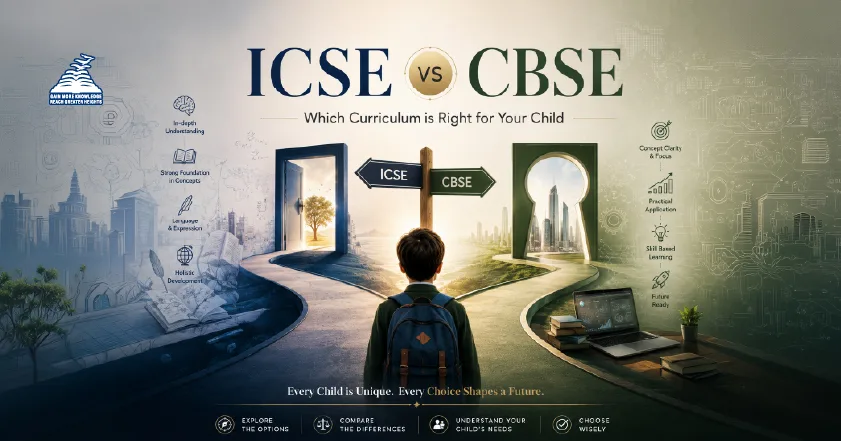
Parents often ask ICSE or CBSE which is better, but the answer depends on the individual child. CBSE may suit students who prefer structured lessons, clear academic milestones and familiarity with NCERT-based materials. ICSE may appeal to children who enjoy reading, detailed explanations, language-based learning and exploring several subjects in depth. Consider your child’s curiosity, confidence, preferred learning pace and ability to manage academic responsibilities before deciding.
Advantages of ICSE Board
The Advantages of ICSE Board are particularly relevant for families seeking a broad academic experience with strong communication development.
Potential benefits include:
- Detailed exposure to English language and literature.
- Balanced attention to science, mathematics and humanities.
- Opportunities for projects, research and practical assignments.
- Development of analytical thinking and written communication.
- Broad academic preparation across multiple disciplines.
- Flexibility to pursue different higher-education pathways.
However, these benefits depend on experienced teachers, appropriate classroom support and a school environment that encourages meaningful learning.
Questions Parents Should Ask Before Choosing CBSE or ICSE
When comparing the best ICSE schools in Bangalore, consider what happens inside the classroom rather than focusing only on reputation or examination results.
Ask the school:
- How does the teaching approach support different learning styles?
- What is the expected homework and project workload?
- How are students supported when they struggle academically?
- What opportunities exist for sports, arts and extracurricular activities?
- How does the school build communication and problem-solving skills?
- Are teachers experienced in delivering the relevant curriculum?
- How does the school prepare students for future academic transitions?
- Can parents verify the school’s current board affiliation?
Ultimately, look Beyond the Board. The right school combines an appropriate curriculum with supportive teachers, balanced expectations and an environment where your child feels confident and motivated to learn.
Choosing the Right Curriculum Starts with Understanding Your Child
The choice between ICSE and CBSE depends on a child’s learning style, academic interests, and long-term goals, as both curricula offer distinct strengths. For families considering an ICSE education, Presidency School Banashankari provides a strong academic environment that encourages in-depth subject understanding, language proficiency, analytical thinking, project-based learning, and balanced development across academics and co-curricular areas. The school’s approach helps students build confidence in communication, strengthen conceptual knowledge, and explore subjects with greater depth rather than focusing only on examinations. With experienced educators, engaging learning experiences, and opportunities for holistic growth, Presidency School Banashankari offers parents a thoughtful choice for nurturing capable, curious, and well-rounded learners.
Conclusion
The choice between ICSE and CBSE should begin with the child, not the board. CBSE can be a strong fit for students who benefit from a structured, nationally consistent curriculum and closer alignment with NCERT-based learning, while ICSE may suit learners who enjoy detailed subject study, extensive reading, projects, and strong language development. Neither curriculum guarantees better outcomes on its own. The quality of teaching, academic support, school culture, workload, extracurricular opportunities, and the child’s comfort with the learning approach matter just as much. For parents comparing ICSE vs CBSE, the most sensible decision is therefore the one that aligns curriculum strengths with the child’s abilities, interests, future plans, and overall well-being.