Mathematics is full of patterns, surprises, and ideas that make us look at numbers differently. Some facts are simple, while others may seem almost unbelievable at first. Learning amazing maths facts can make the subject more enjoyable and help students understand that mathematics is not only about solving sums—it is also about discovering how numbers, shapes, and patterns work.
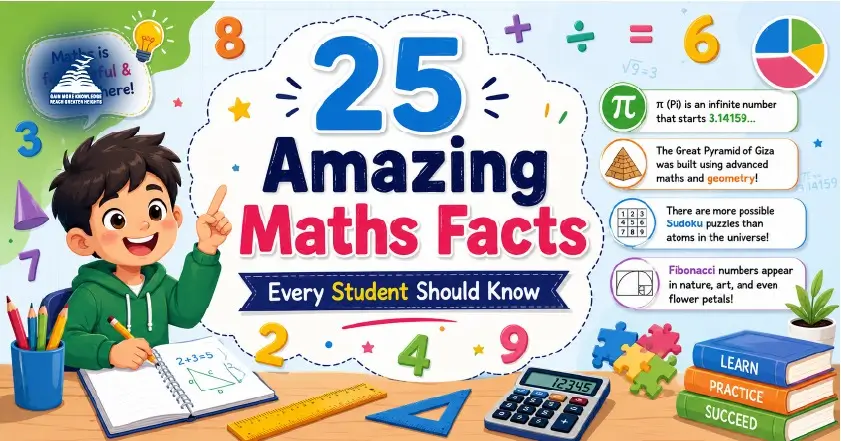
25 Funny Maths Facts
1. Zero Is an Even Number
Zero is an even number because it can be divided by 2 without leaving a remainder. In mathematical terms, zero can be written as 2 × 0. This is one of the most useful Interesting Maths Facts because many students mistakenly think zero is neither odd nor even.
2.Two Is the Only Even Prime Number
A prime number has exactly two positive factors: 1 and itself. Two has the factors 1 and 2, so it is prime. Every other even number can be divided by 2 and therefore has more than two factors. This makes 2 the only even prime number.
3. One Is Neither Prime nor Composite
The number 1 has only one positive factor, which is itself. Prime numbers need exactly two factors, while composite numbers need more than two. Therefore, 1 belongs to neither category. Such Fun Maths Facts help students understand why mathematical definitions must be followed carefully.
4. The Number 0.999… Is Equal to 1
Although it may seem surprising, 0.999 continuing forever is mathematically equal to 1. One simple explanation is that one-third equals 0.333…, and multiplying both sides by 3 gives 1 = 0.999…. This is among the most fascinating Maths Facts for Students because the two numbers appear different but represent the same value.
5. Six Is the Smallest Perfect Number
A perfect number is a number whose positive factors, excluding the number itself, add up to the original number. The factors of 6 are 1, 2, and 3, and their sum is 6. This makes 6 the smallest perfect number.
6. The Angles in a Triangle Add Up to 180 Degrees
No matter whether a triangle is equilateral, isosceles, scalene, or right-angled, the sum of its three interior angles is always 180 degrees in ordinary Euclidean geometry. This is one of the most important Mathematics Facts used in geometry and construction.
7. The First Odd Numbers Create Perfect Squares
The sum of the first n odd numbers always equals n². For example:
- 1 = 1²
- 1 + 3 = 4 or 2²
- 1 + 3 + 5 = 9 or 3²
- 1 + 3 + 5 + 7 = 16 or 4²
8. Zero and One Have Special Multiplication Rules
Any number multiplied by zero becomes zero. Adding zero to a number does not change its value. Similarly, multiplying any number by one keeps it unchanged. These basic rules are simple Interesting Facts About Mathematics, but they form the foundation of algebra and arithmetic.
9. Opposite Faces of a Dice Add Up to Seven
On a standard six-sided dice, the opposite faces are arranged as 1 and 6, 2 and 5, and 3 and 4. Each pair adds up to 7. Students can check this pattern the next time they use a dice in a board game.
10. A Century and Millennium Are Powers of Ten
A century contains 100 years, while a millennium contains 1,000 years. These numbers can be written as 10² and 10³. This is one of the Cool Facts About Maths that connects mathematics with calendars, history, and the measurement of time.
11. A Circle Has Infinitely Many Lines of Symmetry
Any straight line passing through the centre of a circle divides it into two identical halves. Since infinitely many lines can pass through the centre, a circle has infinitely many lines of symmetry.
12. A Square Has Four Equal Sides
A square has four sides of equal length and four right angles of 90 degrees each. It also has four lines of symmetry. Its simple structure makes it one of the most recognisable and useful shapes in mathematics.
13. Pi Is an Irrational Number
Pi, written as π, represents the ratio of a circle’s circumference to its diameter. Its approximate value is 3.14159, but its decimal digits continue forever without repeating in a fixed pattern. These Interesting Facts About Mathematics show why pi is used in calculations involving circles, cylinders, spheres, and waves.
14. The Fibonacci Sequence Appears in Nature
The Fibonacci sequence begins with 0 and 1, and every new number is formed by adding the previous two:
0, 1, 1, 2, 3, 5, 8, 13, 21…
15. Honeybees Use Hexagons Efficiently
Honeybees build honeycombs using hexagonal cells. Hexagons fit together without leaving gaps and can hold a large amount of honey while using less wax. Students in top-rated schools in Bangalore can explore this idea through geometry projects and nature-based learning activities.
16. There Are Infinitely Many Prime Numbers
Prime numbers do not come to an end. More than two thousand years ago, the Greek mathematician Euclid presented a proof showing that there must always be another prime number beyond any given list.
17. Twin Primes Differ by Two
Twin primes are pairs of prime numbers that have a difference of 2. Examples include 3 and 5, 5 and 7, 11 and 13, and 17 and 19. Mathematicians continue to study whether infinitely many twin-prime pairs exist.
18. Every Number Can Be Built from Prime Numbers
Every whole number greater than 1 is either prime or can be expressed as a product of prime numbers. For example, 12 can be written as 2 × 2 × 3. This principle is called the Fundamental Theorem of Arithmetic and is often introduced in the best ICSE schools in Bangalore through factor trees and classroom exercises.
19. Easy Divisibility Rules for 3 and 9
A number is divisible by 3 when the sum of its digits is divisible by 3. For example, the digits of 123 add up to 6, so 123 is divisible by 3. Similarly, if the digit sum is divisible by 9, the original number is also divisible by 9. Such shortcuts make mental calculations easier for students.
20.“Forty” Has Its Letters in Alphabetical Order
The word “forty” is the only English number name whose letters appear in alphabetical order: F, O, R, T, and Y. Interestingly, “one” is the only number name whose letters appear in descending alphabetical order.
21. The Special Number 1729
The number 1729 is known as the Hardy–Ramanujan number. It is the smallest number that can be written as the sum of two positive cubes in two different ways:
- 1³ + 12³ = 1729
- 9³ + 10³ = 1729
This remarkable property is often shared with students in the top 10 ICSE schools in Bangalore to inspire interest in number theory and the life of mathematician Srinivasa Ramanujan.
22. Mathematics Is the Language of Science
Mathematics helps us understand space, engineering, computers, medicine, economics, architecture, and everyday problem-solving. From calculating time to designing bridges, mathematical thinking is everywhere. The best schools in Banashankari Bangalore encourage students to explore mathematics through activities, puzzles, experiments, and real-life examples.
23. A palindrome number reads the same forwards and backwards, such as 121 or 1331.
A palindrome number is a number that reads exactly the same from left to right and from right to left. Examples include 121, 1331, 2002, and 4554. These numbers have a symmetrical digit pattern, making them interesting to explore in maths. Students can also identify palindrome numbers by reversing their digits and checking whether the number remains unchanged.
24. The word “hundred” comes from an old Norse word that originally referred to 120.
The meaning of “hundred” has not always been limited to 100. In some early Germanic counting systems, including Old Norse, a “long hundred” represented 120 items—twelve groups of ten—rather than the ten groups of ten used today. This system was once used for counting goods such as fish, eggs, and other trade items. Over time, the decimal or “short hundred,” meaning exactly 100, became the accepted standard. This fascinating history shows that even familiar mathematical words and counting systems have changed across languages, cultures, and historical periods.
25. A number is divisible by 9 when the sum of its digits is divisible by 9.
A number is divisible by 9 when the sum of all its digits is also divisible by 9. For example, in the number 7,245, the digits add up to 7 + 2 + 4 + 5 = 18. Since 18 is divisible by 9, the number 7,245 is also divisible by 9. This simple divisibility rule helps students quickly check large numbers without performing long division.
Timeline of Mathematical Discoveries
This timeline offers Interesting Facts About Mathematics across cultures and centuries.
| Period | Development |
| Around 3000 BCE | Early civilisations used arithmetic and measurement |
| Around 800–500 BCE | The Sulba Sutras recorded Indian geometrical methods |
| Around 300 BCE | Euclid organised geometry in Elements |
| 499 CE | Aryabhata completed the Aryabhatiya |
| 628 CE | Brahmagupta wrote rules involving zero and negative numbers |
| Around 820 CE | Al-Khwarizmi advanced algebraic methods |
| 1202 CE | Fibonacci helped spread Hindu-Arabic numerals in Europe |
| 1637 CE | Descartes connected algebra with geometry |
| Late 1600s | Newton and Leibniz independently developed calculus |
| Modern era | Computers expanded modelling and data analysis |
Great Mathematicians Who Changed the Way We Calculate
Many Cool Facts About Maths are linked to thinkers who transformed geometry, algebra, number theory, calculus, and astronomy.
Table of Famous Mathematicians
| Mathematician | Well-Known Contribution |
| Euclid | Foundations of geometry |
| Archimedes | Geometry, measurement, and mechanics |
| Aryabhata | Mathematics and astronomy |
| Brahmagupta | Zero, negative numbers, and equations |
| Al-Khwarizmi | Algebra and systematic calculation |
| René Descartes | Cartesian geometry |
| Isaac Newton | Calculus and mathematical physics |
| Gottfried Leibniz | Calculus notation |
| Carl Friedrich Gauss | Number theory and statistics |
| Srinivasa Ramanujan | Number theory and infinite series |
Interesting Facts About Indian Mathematicians
India’s mathematical heritage provides several Interesting Facts About Mathematics that can inspire young learners.
Aryabhata
Aryabhata completed his renowned work, Aryabhatiya, in 499 CE when he was around 23 years old. He made significant contributions to mathematics and astronomy, including a close approximation of pi and important developments in trigonometry.
Brahmagupta
Brahmagupta introduced systematic rules for working with positive numbers, negative numbers, and zero. His studies also covered quadratic equations, geometry, mathematical series, and astronomy, making him one of India’s most influential mathematicians.
Srinivasa Ramanujan
Srinivasa Ramanujan made remarkable contributions to number theory, partitions, continued fractions, and infinite series. The number 1729 is famously associated with him as the smallest positive integer that can be expressed as the sum of two positive cubes in two different ways.
Why Maths Is Essential for Science and Technology
Schools build strong numerical foundations because Physics, Chemistry, Economics, Engineering, Artificial Intelligence, and Data Science depend on measurement, equations, patterns, and logical reasoning.
Scientists analyse results, programmers develop algorithms, doctors interpret health data, and engineers test designs. The top ICSE schools in Bangalore can strengthen these links through coding tasks, laboratory calculations, models, puzzles, and projects.
Making Mathematics Exciting Through Amazing Facts
Learning 30 amazing maths facts every student should know helps children see mathematics as more than numbers, formulas, and calculations—it becomes a subject full of patterns, logic, creativity, and real-life connections. At Presidency School Banashankari, students are encouraged to explore interesting maths facts, number tricks, shapes, puzzles, patterns, and everyday applications that make learning enjoyable and meaningful. These fun discoveries help build curiosity, improve problem-solving skills, strengthen logical thinking, and reduce fear of mathematics. With engaging classroom activities, concept-based teaching, and supportive guidance, Presidency School Banashankari inspires students to develop confidence in maths and appreciate its importance in academics, technology, science, and daily life.
Conclusion
Mathematics contains stories, patterns, and discoveries that reach beyond the classroom. Zero transformed calculation, prime numbers continue without end, geometry shapes the built world, and mathematical logic powers technology. Such facts encourage students to question confidently and appreciate maths as a creative way to understand life.